Toyota Land Cruiser Ambulance: Heavy-Duty 4×4 Medical Solutions

When the United Nations deploys a medical team into a conflict zone, when a mining company needs onsite trauma support three hundred kilometers from the nearest paved road, or when a disaster response team must reach communities cut off by earthquakes—they almost always arrive in a Toyota Land Cruiser.
The Land Cruiser is not simply another 4×4. It is a purpose-built heavy-duty platform designed for operations where failure is not an option. Unlike lighter vehicles adapted for medical use, the Land Cruiser starts life with one goal: to survive the worst conditions on earth and keep going. For medical missions, that foundation is invaluable.
What Is a Toyota Land Cruiser Ambulance?
A Toyota Land Cruiser ambulance typically begins as a 70 Series cab and chassis or a troop carrier variant. These are not civilian comfort vehicles. They are commercial-grade machines with ladder frames, solid axles, and mechanical components prioritized for durability over refinement.
Specialist converters take these base vehicles and fit medical bodies tailored to the mission. The result is an ambulance that carries patients and medical teams through terrain that stops other vehicles entirely.
Typical operators include military medical corps, international humanitarian organizations, government disaster response agencies, and extractive industries operating in remote regions. These users share one requirement: the vehicle must reach the patient, regardless of what lies in between.
Built for Extreme Terrain & Harsh Environments
The 70 Series Land Cruiser employs a live axle front and rear suspension setup. This configuration provides maximum wheel articulation, keeping tires in contact with the ground over boulders and through deep ruts. Independent suspension systems cannot match this off-road capability.
Ground clearance exceeds most competitors significantly. The chassis rails sit high above the terrain, protecting the drivetrain and medical module from impact damage. Approach and departure angles allow the vehicle to climb steep embankments and descend into river crossings without hanging up on the bumpers.
Payload capacity deserves specific attention. A Toyota Land Cruiser ambulance carries not only patients and attendants but also water, fuel, medical supplies, and recovery gear. In remote operations, self-sufficiency matters. The Land Cruiser hauls what the team needs to sustain itself for days away from support.
Box-Type vs Hard-Top Land Cruiser Ambulances
Two primary configurations dominate Land Cruiser ambulance conversions, each serving different operational needs.
The hard-top configuration retains the original troop carrier body style. This approach keeps the vehicle narrow and nimble, with excellent approach angles for technical off-road driving. Interior space remains limited but sufficient for basic life support and casualty evacuation. Military units often prefer hard-top ambulances because they can follow armored columns through tight terrain.
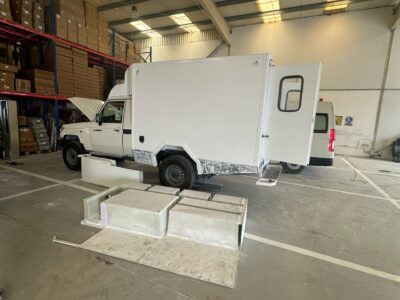
The Toyota Land Cruiser box type ambulance takes a different approach. Converters remove the original body and mount a dedicated medical module on the chassis. This module extends outward, creating standing height and significantly more interior volume. The trade-off comes in slightly reduced off-road clearance at the module edges, though careful design minimizes this limitation.
Field maintenance favors the box-type configuration. If the medical module sustains damage from a rollover or impact, crews can unbolt it and replace it without scrapping the entire vehicle. The mechanical running gear remains serviceable.
Medical Interior & Equipment Capability
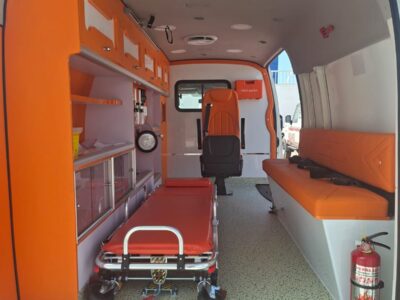
Inside a Land Cruiser ambulance, every component must withstand violent motion. Standard medical equipment mounts using anti-vibration fixtures tested to military shock standards.
Stretcher systems lock securely during transport but release instantly for loading. Oxygen cylinders secure in crash-tested brackets with remote controls for emergency shutoff. Electrical systems isolate medical loads from the starting battery, ensuring the engine always cranks.
Climate control proves essential in extreme environments. In desert operations, interior temperatures can exceed fifty degrees Celsius. High-capacity air conditioning systems maintain safe conditions for patients and preserve medication efficacy. In arctic operations, auxiliary heaters prevent hypothermia during prolonged extractions.
For ICU-capable configurations, the Toyota Land Cruiser ambulance accommodates ventilators, multiparameter monitors, infusion pumps, and suction apparatus. The robust electrical system supports these loads without taxing the alternator beyond its capacity.
Typical Use Cases
The Land Cruiser platform supports medical operations across the entire spectrum of challenging environments:
- Humanitarian aid missions: Supporting mobile clinics in conflict zones and refugee camps
- Disaster and emergency relief: Reaching communities isolated by earthquakes, floods, or landslides
- Military and peacekeeping operations: Providing casualty evacuation under threat conditions
- Remote mining and oil projects: Maintaining onsite medical coverage at extreme locations
- Expedition medicine: Supporting scientific and exploration teams in polar or desert regions
- Border security medical support: Responding to incidents along remote international frontiers
Comparison Table
| Configuration | Interior Space | Terrain Capability | Medical Capability | Typical Operators |
|---|---|---|---|---|
| Hard-Top Land Cruiser | Limited (seated attendants) | Extreme (technical off-road) | BLS, casualty evacuation | Military, special operations |
| Box-Type Land Cruiser | Full walk-in (standing height) | High to Extreme | ALS, ICU, surgical support | NGOs, humanitarian, mining |
Why Choose a Toyota Land Cruiser Ambulance?
The decision to invest in a ambulance Toyota Land Cruiser often comes down to one factor: trust. Organizations operating in high-risk environments cannot afford vehicles that break.
Reliability is not marketing language with the Land Cruiser. These vehicles routinely log five hundred thousand kilometers or more with nothing but routine maintenance. The diesel engines tolerate poor fuel quality that would destroy more refined powerplants. The drivetrain withstands abuse from inexperienced drivers in challenging terrain.
Global parts availability matters enormously. Toyota maintains distribution networks in countries where other manufacturers have no presence. A broken component in South Sudan or the Amazon basin can be replaced within days, not weeks.
Lifecycle value exceeds other platforms. Land Cruisers retain resale value because the market knows they keep running. Organizations can rotate fleets and recover significant capital after years of demanding service.
Conclusion
The Toyota Land Cruiser ambulance represents the pinnacle of heavy-duty medical vehicle design. It combines genuine off-road capability with sufficient interior volume for advanced medical care, all built on a foundation legendary for durability.
For NGOs crossing borders into active conflict zones, for military units requiring casualty evacuation under fire, for disaster response teams reaching the unreachable—the Land Cruiser delivers patients to care and caregivers to patients. When the mission cannot fail, and the terrain cannot be avoided, this is the vehicle the world trusts.
Frequently Asked Questions
Is the Toyota Land Cruiser suitable for ICU ambulance conversion?
Yes, particularly in box-type configuration. The walk-in medical module provides full standing height for medical staff and sufficient space for ventilators, patient monitors, infusion pumps, medical gas systems, and storage. The Land Cruiser’s heavy-duty electrical architecture supports continuous operation of life-support equipment during long and demanding missions.
What is the difference between hard-top and box-type Land Cruiser ambulances?
A hard-top Land Cruiser ambulance retains the original troop carrier body, offering excellent mechanical simplicity and superior extreme off-road capability, but with limited interior standing height and medical workspace.
A box-type Land Cruiser ambulance replaces the rear body with a dedicated medical module, providing standing height, greater patient capacity, and more flexible ICU layouts, with a small trade-off in extreme terrain maneuverability.
Why is the Land Cruiser preferred for humanitarian missions?
Humanitarian organizations frequently operate in regions with poor road infrastructure, inconsistent fuel quality, extreme temperatures, and limited access to service facilities. The Toyota Land Cruiser is proven to tolerate these conditions better than most alternatives. Its global spare parts availability and mechanical reliability ensure vehicles remain operational even in the most remote locations.
Can a Land Cruiser ambulance operate in extreme climates?
Absolutely. Toyota Land Cruiser ambulances are regularly deployed in desert environments exceeding 50°C as well as arctic and high-altitude regions below freezing temperatures. When properly specified, advanced climate control, insulation, and engine cooling systems maintain patient safety and equipment reliability across this entire operational range.
What type of organizations typically use Land Cruiser ambulances?
Toyota Land Cruiser ambulances are widely used by international NGOs, military medical units, disaster response agencies, border and peacekeeping forces, and remote industrial operators that require maximum reliability, long service life, and mission-critical performance in harsh environments.