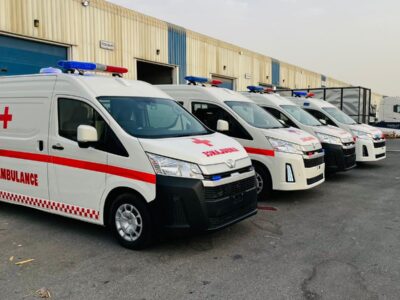
Toyota Ambulance Models: Hilux, Hiace & Land Cruiser Compared

When an emergency call comes in, the vehicle responding needs to be more than just a mode of transport—it needs to be a reliable, Toyota Ambulance Models. In the world of global EMS and humanitarian aid, one name rises above the rest for durability: Toyota.
You see Toyota ambulances operating everywhere, from the gridlocked streets of Jakarta to the remote sand tracks of the Sahara. The reason is simple. These platforms offer unmatched reliability, a global parts network, and incredible versatility. However, choosing the right base vehicle is critical. You cannot send a vehicle designed for highways into a flood zone, nor can you use a rugged 4×4 for high-volume urban patient transfers.
This guide breaks down the three pillars of the Toyota ambulance lineup—the Hilux, the Hiace, and the Land Cruiser—to help you determine which chassis is the right foundation for your next medical mission.
What Is a Toyota Ambulance Models ?
A Toyota ambulance isn’t a single vehicle manufactured by the factory; rather, it is a standard Toyota commercial platform—a cab and chassis—that is sent to a specialist converter to be fitted with a medical body and interior.
These ambulances are the backbone of pre-hospital care in developing nations and remote regions because they can withstand extreme heat, rough roads, and neglectful maintenance better than most competitors. Whether it is a Basic Life Support (BLS) unit for a rural clinic or a Mobile ICU for a military convoy, the Toyota badge ensures the vehicle starts every single time. Their widespread availability means if a part breaks in a remote village, a replacement is rarely more than a few days away.
Toyota Hilux Ambulance – Built for Off-Road & Rescue Missions
If your operational theater lacks paved roads, the Toyota Hilux ambulance is your only real option. Known globally as the “Indestructible” pickup, the Hilux forms the backbone of rescue services in mountainous regions, oil fields, and desert outposts.
There are two primary configurations here. The first is a rapid response unit, where the pickup bed is fitted with a canopy to carry rescue gear and a single stretcher. The second, more comprehensive option, is a box-type ambulance mounted on the rear chassis.
The Hilux excels where roads end. Its 4×4 drivetrain and high ground clearance allow it to ford rivers and climb muddy tracks that would swallow a standard van. Furthermore, its mechanical simplicity means local mechanics can repair it with basic tools, ensuring long-term durability in the harshest environments.
Toyota Hiace Ambulance – Urban EMS & Patient Transport
For the majority of EMS providers operating in cities and towns, the Toyota Hiace ambulance is the workhorse of choice. As a van-based platform, the Hiace offers something the Hilux cannot: a unified, aerodynamic body with a walk-through cabin.
Converters typically use the Hiace in two roof heights. The standard roof is perfect for basic patient transport and non-emergency transfers, offering better fuel economy and maneuverability in tight traffic. The high roof version, however, is the gold standard for urban EMS. It allows paramedics to stand upright while attending to a patient, facilitating advanced airway management and CPR during transit.
The Hiace also provides a smoother ride on paved surfaces compared to leaf-sprung 4x4s, ensuring patient comfort and reducing motion stress during long hospital transfers.
Toyota Land Cruiser Ambulance – Heavy-Duty Medical Operations
When you combine the off-road capability of the Hilux with the interior space of the Hiace, you get the Toyota Land Cruiser ambulance. Specifically built on the heavy-duty 70 Series chassis, this is a purpose-built machine for extreme conditions.
Unlike the Hilux, which is a utility vehicle adapted for medical use, the Land Cruiser 70 is often configured as a factory “troop carrier” or a cab/chassis for a large box body. This makes it the preferred choice for military field hospitals and major disaster relief operations.
The Land Cruiser offers superior payload capacity, meaning it can carry more medical equipment, water, and fuel. It is built to traverse rocky terrain at low speeds while protecting the patient in a reinforced steel body. If you are deploying into a war zone or an active volcanic area, this is the ambulance Toyota engineers trust to bring everyone back.
Comparison Table Toyota Ambulance Models
| Model | Drive Type | Best Use Case | Terrain Capability | Interior Space | Typical Ambulance Configuration |
|---|---|---|---|---|---|
| Toyota Hilux | 4×4 | Remote rescue, mining camps, wildfire support | High (Off-road focus) | Low (Pickup/Box body) | Rescue vehicle or 2-stretcher box unit |
| Toyota Hiace | 4×2 / 4×4 | Urban EMS, hospital transfers, BLS/ICU | Medium (Paved roads) | High (Walk-through van) | Single stretcher ICU or multi-patient |
| Land Cruiser 70 | 4×4 | Military, heavy disaster response, humanitarian | Very High (Extreme terrain) | Medium-High (Troop carrier/Box) | Field surgical unit or armored transport |
Which Toyota Ambulance Is Right for Your Mission?
Choosing the right platform is about matching the vehicle’s DNA to your specific geography and clinical requirements.
- If your mission requires reaching victims in the mountains or dense jungles where roads are non-existent, the Toyota Hilux ambulance is your only choice. It prioritizes getting there over patient comfort.
- If your mission requires high-volume response in a capital city, with a need for paramedics to work standing up, the high-roof Toyota Hiace ambulance is the most practical and cost-effective solution.
- If your mission requires the highest level of durability for a government contract, or you need to carry a heavy surgical team and equipment into a hostile environment, the Toyota Land Cruiser ambulance offers the fortified reliability you need.
Budget also plays a role. The Hiace generally offers the lowest entry cost and best fuel efficiency for paved roads, while the Land Cruiser commands a premium for its go-anywhere capability and longevity.
Conclusion Toyota Ambulance Models
There is no single “best” Toyota ambulance, only the best one for the job. The global success of the Hilux, Hiace, and Land Cruiser lies in their adaptability. Whether you are equipping a rural clinic in Africa or a metropolitan EMS agency in South America, Toyota provides the dependable foundation.
By carefully assessing your terrain, your clinical level, and your operational radius, you can select the platform that will serve your community for decades. When lives are on the line, the reliability of a Toyota ambulance ensures that help always arrives.
What is the best Toyota ambulance for off-road use?
The Toyota Hilux ambulance is one of the best options for extreme off-road and rural operations. Its proven 4×4 drivetrain, high ground clearance, and robust suspension allow it to operate reliably in remote areas where standard van-based ambulances cannot reach. For heavier-duty missions, box-type Hilux conversions are commonly preferred.
Is the Toyota Hiace suitable for ICU ambulance conversion?
Yes. The high-roof Toyota Hiace ambulance is widely used for ICU and advanced life support conversions. Its interior height allows medical staff to work upright, while the long wheelbase provides sufficient space for stretchers, ventilators, monitors, and multiple attendants, making it ideal for urban EMS and inter-hospital transfers.
What is the difference between a box-type ambulance and a van ambulance?
A van ambulance, such as the Toyota Hiace, uses the vehicle’s original body, offering better aerodynamics, lower weight, and easier urban maneuverability.
A box-type ambulance, commonly built on Toyota Hilux or Land Cruiser chassis, uses a modular medical box mounted on the frame. Box-type ambulances provide greater interior customization, easier repairs in harsh conditions, and are preferred for off-road, humanitarian, and long-duration missions.
Which Toyota ambulance is best for NGOs and humanitarian missions?
For demanding humanitarian and NGO operations in remote regions, the Toyota Land Cruiser 70 Series ambulance is often the first choice. It combines exceptional off-road capability, high payload capacity for medical supplies, and legendary durability. For less extreme terrain and tighter budgets, the Toyota Hilux ambulance offers a reliable and cost-effective alternative.