Types of Toyota Ambulances & How to Choose the Right One

Selecting an ambulance is not simply a vehicle purchase. It is an operational decision that affects patient outcomes, crew safety, and long-term budget viability Types of Toyota Ambulances. The wrong platform strains resources. The right one extends reach and saves lives.
Toyota dominates the global ambulance landscape for good reason. The Hilux, Hiace, and Land Cruiser platforms provide a foundation of reliability that specialized converters transform into medical vehicles. But understanding the types of Toyota ambulances requires looking beyond the badge. Configuration determines capability.
This guide breaks down the distinct ambulance categories built on Toyota chassis. Whether you operate urban emergency services, remote humanitarian missions, or military medical units, matching the vehicle type to your environment ensures your investment delivers.
What Defines an Ambulance Type?
Before comparing specific models, understanding the factors that define an ambulance type helps clarify the options.
Chassis type determines where the vehicle can go. Light-duty van chassis suit paved roads. Heavy-duty truck chassis with 4×4 systems handle mountains and deserts.
Body structure separates van ambulances from box-type ambulances. Van bodies integrate with the cab. Box bodies mount separately on the chassis frame.
Terrain capability flows directly from these fundamentals. Ground clearance, suspension travel, and drivetrain configuration dictate operational boundaries.
Medical capability ranges from basic patient transport to full intensive care. Interior volume determines what equipment fits and whether staff work seated or standing.
Operational environment ties everything together. Urban fleets need maneuverability. Remote operators need self-sufficiency.
Van-Based Toyota Ambulances
The Toyota van ambulance category centers on the Hiace platform. These vehicles represent the mainstream of global urban EMS for practical reasons.
Van ambulances retain the original factory body shell. Converters fit medical interiors without structural modification to the outer skin. This approach delivers excellent aerodynamics and fuel economy compared to box-type designs. The lower center of gravity improves handling through city traffic.
Interior configurations vary by roof height. Standard roof versions suit basic life support and patient transport. High roof versions provide standing height, enabling advanced life support and intensive care during transit.
Urban EMS providers favor van ambulances for their driving dynamics. Crews can negotiate narrow streets and congested roundabouts confidently. Hospital networks appreciate the lower operating costs compared to heavier platforms.
For a deeper look at roof configurations, read our detailed Toyota Hiace Ambulance: Standard Roof vs High Roof vs Extended Roof guide.
Pickup-Based Toyota Ambulances
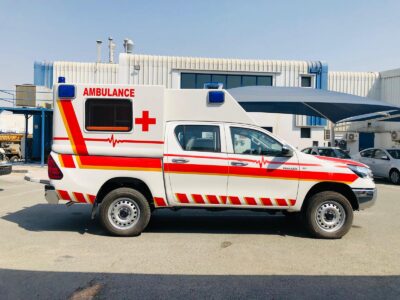
The Toyota Hilux ambulance represents a different philosophy. Built on the legendary Hilux pickup, these vehicles prioritize access over interior volume.
Two distinct configurations exist. The first uses a reinforced canopy on the pickup bed. This creates a secure weatherproof space for a stretcher and rescue equipment. Rapid response teams favor this setup for its maneuverability on tight trails.
The second configuration mounts a box-type module on the rear chassis. This Toyota box type ambulance provides enclosed patient care with standing height, though interior space remains more limited than van alternatives.
Rural EMS agencies and humanitarian organizations operating beyond paved roads rely on Hilux ambulances. The 4×4 drivetrain and high ground clearance reach patients in locations van ambulances cannot approach.
For detailed configuration guidance, see our Toyota Hilux Ambulance: 4×4 Rescue & Box-Type Configurations article.
Box-Type Toyota Ambulances
Box-type construction deserves attention as a distinct category. While both Hilux and Land Cruiser platforms accept box bodies, the approach offers specific advantages regardless of base vehicle.
A box-type ambulance mounts a separate medical module on the chassis frame. This module can be constructed from composite materials, aluminum, or steel. It bolts to the chassis rather than integrating with the cab structure.
The modular nature provides significant field advantages. If the medical module sustains damage from a rollover or impact, crews can unbolt and replace it. The mechanical running gear continues service. This interchangeability proves valuable in remote operations where replacement vehicles are scarce.
Interior volume exceeds van conversions of similar wheelbase length. Box-type construction allows full standing height across the entire patient area. Wall cavities accommodate medical gas lines and electrical wiring without competing with factory body panels.
Heavy-Duty 4×4 Toyota Ambulances
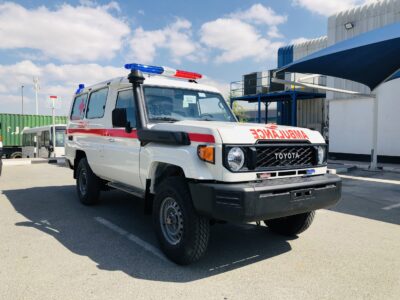
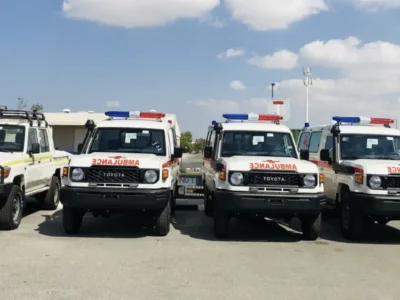
The Toyota Land Cruiser ambulance sits at the top of the capability pyramid. Built on the 70 Series platform, these vehicles handle conditions that stop other ambulances entirely.
Heavy-duty 4×4 ambulances employ live axle suspension front and rear. This configuration provides maximum wheel articulation, keeping tires in contact with the ground over extreme terrain. Ground clearance exceeds typical van ambulances significantly.
Payload capacity supports extended autonomous operations. These vehicles carry not only patients and attendants but also fuel, water, supplies, and recovery equipment. Military units and humanitarian organizations operating in remote regions depend on this self-sufficiency.
Climate systems handle the full environmental spectrum. Properly specified Land Cruiser ambulances maintain patient-safe interiors from arctic cold to desert heat exceeding fifty degrees Celsius.
For comprehensive specifications, explore our Toyota Land Cruiser Ambulance: Heavy-Duty 4×4 Medical Solutions feature.
Comparison Table
| Ambulance Type | Base Vehicle | Terrain Capability | Medical Capability | Typical Use Case |
|---|---|---|---|---|
| Van Ambulance | Toyota Hiace | Paved roads, light gravel | BLS to ALS/ICU (high roof) | Urban EMS, hospital transfers |
| Pickup Ambulance | Toyota Hilux | Moderate to extreme off-road | BLS, rescue, basic ALS | Rural response, remote clinics |
| Box-Type Ambulance | Hilux or Land Cruiser | Moderate to extreme (depends on base) | ALS to full ICU | Custom missions, interchangeable modules |
| Heavy-Duty 4×4 | Toyota Land Cruiser 70 | Extreme (desert, mountain, jungle) | BLS to surgical support | Military, humanitarian, disaster response |
How to Choose the Right Toyota Ambulance
Decision frameworks help match vehicle type to operational reality. Consider your primary environment and clinical requirements.
If your operation is urban with good road infrastructure, the Toyota van ambulance in high roof configuration delivers the best combination of maneuverability, fuel economy, and clinical space. Standard roof suits basic transport services on tighter budgets.
If your mission is rural or off-road with significant travel on unsealed roads, the Toyota Hilux ambulance provides essential ground clearance and 4×4 capability. Pickup canopy configurations work for rescue-focused teams. Box-type bodies support more advanced care.
If you require ICU capability with standing attendance throughout transport, ensure your chosen platform offers adequate interior height. High roof vans and box-type configurations on either Hilux or Land Cruiser chassis meet this requirement.
If you operate in extreme environments with severe terrain, temperature extremes, or limited support infrastructure, invest in the Toyota Land Cruiser ambulance. The heavy-duty mechanicals and global parts network justify the additional investment through mission reliability.
If you require module interchangeability or plan to operate multiple modules from a single chassis fleet, box-type construction on either Hilux or Land Cruiser bases provides maximum flexibility.
Conclusion
The range of types of Toyota ambulances reflects the diversity of global emergency medical operations. No single configuration serves every mission. Van ambulances dominate cities. Pickup ambulances reach remote villages. Heavy-duty 4×4 platforms support the most demanding humanitarian and military operations.
Toyota provides the reliable foundation. Specialist converters tailor the medical interior. Your responsibility as an operator is matching the combination to your specific environment and clinical requirements. Do that correctly, and the vehicle becomes a force multiplier for your entire medical system.
Frequently Asked Questions
What are the main types of Toyota ambulances?
Toyota ambulances are generally grouped into three main categories. Van-based ambulances, primarily built on the Toyota Hiace, are optimized for urban and highway emergency medical services. Pickup-based ambulances, typically based on the Toyota Hilux, are available in canopy or box-type configurations and are designed for mixed urban–rural and off-road use. Heavy-duty 4×4 ambulances, built on the Toyota Land Cruiser 70 Series chassis, are engineered for extreme terrain, humanitarian missions, and operations in regions with limited infrastructure.
Which Toyota ambulance is best for city EMS operations?
For city and metropolitan emergency medical services, the Toyota Hiace high-roof ambulance is generally the best choice. Its van-based design offers excellent maneuverability in traffic, lower fuel consumption compared to 4×4 platforms, and sufficient interior standing height for advanced life support procedures. These characteristics make it ideal for frequent dispatches, shorter response times, and paved-road environments.
What is the difference between van and box-type ambulances?
A van ambulance retains the original factory body shell of the vehicle, resulting in lower overall weight, improved aerodynamics, and reduced fuel consumption. This configuration is well suited for urban and intercity use.
A box-type ambulance, by contrast, mounts a dedicated medical module onto the vehicle chassis. This allows for greater interior volume, fully customizable layouts, modular interchangeability, and easier repair or replacement of the medical compartment in harsh operating environments.
Which Toyota ambulance is best for off-road use?
For most rural and semi-off-road applications, the Toyota Hilux ambulance provides an excellent balance of off-road capability, payload capacity, and cost efficiency. In environments involving extreme terrain, long distances, poor fuel quality, or heavy medical payloads, the Toyota Land Cruiser 70 Series ambulance is the preferred solution due to its legendary durability, heavy-duty drivetrain, and global serviceability.
How do I choose the right ambulance type for my operation?
Selecting the right ambulance platform requires evaluating several operational factors. Primary terrain determines whether a van or 4×4 chassis is appropriate. Medical capability requirements, such as basic life support or ICU-level care, dictate interior height and module size. Transport distances and maintenance infrastructure availability also play a critical role. Urban, paved-road operations typically favor van ambulances, while remote or undeveloped regions require Hilux or Land Cruiser platforms. Regardless of the base vehicle, ICU missions demand sufficient interior height and electrical capacity to support life-support equipment.