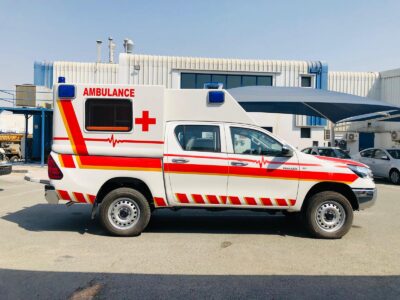
Toyota Hiace Ambulance: Standard Roof vs High Roof vs Extended Roof

Toyota Hiace Ambulance By Infinity Chassis Engineering Team – ISO 9001:2015 & EN1789 Certified Toyota Ambulance Manufacturer
Introduction
Walk into any major city across the developing world, and the ambulance you see responding to emergencies will likely be a Toyota Hiace. This van platform has become the default choice for urban EMS for one simple reason: it works.
The Hiace offers the perfect balance of maneuverability, reliability, and interior space. However, not all Hiace ambulances are created equal. The roof height and body length determine what medical procedures you can perform inside and how many patients you can carry. Choosing between standard, high, and extended roof configurations directly impacts your clinical capability and operational efficiency.
In this guide, we break down each configuration to help you make the right choice for your EMS operation.
What Is a Toyota Hiace Ambulance?
A Toyota Hiace ambulance begins as a factory van body, which specialist converters transform into a mobile medical unit. Unlike box-type ambulances built on truck chassis, the Hiace retains its original shell. This gives it superior aerodynamics, better fuel economy, and a lower center of gravity.
Why van ambulances dominate urban EMS:
| Advantage | Explanation |
|---|---|
| Handling | Drives like a large car, not a truck |
| Maneuverability | Negotiates narrow streets and tight roundabouts with confidence |
| Fuel economy | Better than box-type designs |
| Noise control | Unified body provides better insulation |
| Cost | Lower purchase and conversion costs |
Typical operators include:
- Municipal EMS agencies
- Private hospital networks
- Private patient transport companies
- Clinics and nursing homes
These organizations need vehicles that can run twelve-hour shifts, day after day, without mechanical failure.
Standard Roof Toyota Hiace Ambulance
Overview
The standard roof configuration represents the entry point into Hiace ambulance ownership. Interior height typically measures around 1,350 mm (53 inches) , which means medical staff cannot stand upright. They work seated or slightly stooped.
Clinical Role
This limitation defines the clinical role. Standard roof units excel at:
| Application | Description |
|---|---|
| Basic Life Support (BLS) | Essential care for stable patients |
| Non-emergency patient transport | Inter-facility transfers |
| Dialysis transport | Routine appointments |
| Hospital discharges | Returning stable patients home |
Advantages
| Advantage | Explanation |
|---|---|
| Lower cost | Less expensive to purchase and convert |
| Better fuel economy | Reduced height improves aerodynamics |
| Lower profile | Easier to park in standard garages |
| Lighter weight | Less wear on suspension components |
| Reduced wind noise | Better highway experience |
Best For
- Private transport operators on tight margins
- Nursing homes and clinics
- Non-emergency patient transfers
- BLS-only services
- Budget-conscious buyers
High Roof Toyota Hiace Ambulance
Overview
The high roof configuration transforms the clinical possibilities of the platform. With interior height exceeding 1,900 mm (75 inches) , paramedics and nurses can stand fully upright while working on patients. This seemingly small difference fundamentally changes patient care.
Clinical Advantages
| Advantage | Explanation |
|---|---|
| Standing height | Enables advanced airway management and CPR with proper posture |
| Reduced fatigue | Clinicians maintain proper body mechanics |
| Better patient access | Easier to work from both sides of stretcher |
| Improved ergonomics | Equipment at comfortable heights |
Equipment Benefits
- Cabinets, monitors, and infusion pumps can be positioned at ergonomic heights
- Additional vertical space improves airflow and infection control
- Contaminated aerosols have more volume to disperse
Best For
- ALS (Advanced Life Support) missions
- ICU transfers
- 911 emergency response
- Municipal EMS agencies
- Services where paramedics work standing during transport
Extended Roof & Extended Length Configurations
Overview
Beyond the high roof, Toyota offers extended length variants that push the Hiace platform to its maximum dimensions. These vehicles add crucial centimeters of rear body length, creating space for advanced clinical layouts.
Key Benefits
| Benefit | Application |
|---|---|
| Multiple stretchers | Transport two patients simultaneously |
| Mass casualty response | Increased capacity during incidents |
| Family accompaniment | Space for family members during transfers |
| Incubator positioning | Full access for neonatal teams |
| Expanded storage | Additional oxygen cylinders, suction units, medications |
Attendant Seating
Extended bodies provide room for bench seating along the sidewalls, enabling multiple medical staff to accompany critical patients. Teaching hospitals often prefer these configurations because they allow paramedic students to observe during transfers.
Best For
- Critical care transport
- Mass casualty incidents
- Neonatal ICU (NICU) teams
- Teaching hospitals
- Military and disaster response
Toyota Hiace Ambulance Roof Comparison Table
| Configuration | Interior Height | Best Use Case | Medical Capability | Typical Operators |
|---|---|---|---|---|
| Standard Roof | ~1,350 mm (53″) | Non-emergency transport, BLS transfers | Basic Life Support, stable patients | Private transport, nursing homes |
| High Roof | ~1,900 mm (75″) | Urban EMS, emergency response | ALS, ICU, standing clinical work | Municipal EMS, hospital networks |
| Extended Roof/Length | ~1,900 mm (75″) | Critical care, mass casualty, teaching | Advanced ICU, multiple patients, incubators | Tertiary hospitals, military, disaster response |
Toyota Hiace Ambulance Interior & Medical Layout
Clinical Zones
Regardless of roof height, the interior of a Toyota Hiace ambulance follows established ergonomic principles:
| Zone | Location | Purpose |
|---|---|---|
| Stretcher area | Central or side-mounted | Patient transport and treatment |
| Action area | Beside stretcher | Clinical procedures, CPR |
| Equipment storage | Overhead and under-seat | Medical supplies, monitors |
| Attendant seating | Side or rear | Crew positioning during transport |
Medical Gas Distribution
| Component | Placement | Requirement |
|---|---|---|
| Oxygen outlets | Head of stretcher | Primary supply |
| Secondary outlets | Portable cylinder position | Backup supply |
| Suction units | Securely mounted | Anti-vibration fittings |
Electrical Systems
| Feature | Specification |
|---|---|
| Starting battery | Isolated from medical loads |
| Auxiliary batteries | Deep-cycle, power lights, monitors, inverters |
| Battery separator | Automatic isolation |
| Inverter | Pure sine wave for medical devices |
Infection Control
| Surface | Material | Benefit |
|---|---|---|
| Walls | Smooth, non-porous | Withstands repeated disinfection |
| Flooring | Seamless with coved corners | Prevents fluid accumulation |
| Cabinetry | Anti-bacterial surfaces | Easy to clean |
When Is the Toyota Hiace the Right Ambulance Choice?
Choose Hiace If:
| Requirement | Why Hiace |
|---|---|
| Frequent response through congested streets | Superior maneuverability over truck-based ambulances |
| ALS during transport | High roof provides essential working height |
| Neonatal or critical care with multiple attendants | Extended length offers necessary interior volume |
| Simple patient transfers | Standard roof delivers lowest operating cost |
| Need global parts availability | Toyota network worldwide |
Choose Hilux or Land Cruiser If:
| Requirement | Why Other Platforms |
|---|---|
| Extreme off-road operations | Hiace has limited ground clearance |
| Four-wheel drive required | Hiace is RWD standard (AWD in some markets) |
| Heavy-duty payload | Hilux or Land Cruiser have higher capacity |
| Military or mining applications | Land Cruiser 70 Series preferred |
Frequently Asked Questions
Q: Is the Toyota Hiace suitable for ICU ambulance conversion?
A: Yes, but only in the high roof configuration. Standing height is essential for ICU and ALS procedures during transport. Extended length high-roof versions provide additional space for ventilators, patient monitors, infusion pumps, oxygen systems, and multiple attendants.
Q: What is the difference between standard roof and high roof Hiace ambulances?
A: A standard roof Hiace does not allow medical staff to stand upright, limiting use to BLS and patient transport. A high roof Hiace enables full standing height, allowing ALS procedures, continuous patient monitoring, and safer working conditions during transit.
Q: How many medical staff can work inside a Hiace ambulance?
A: Standard roof configurations typically limit to one medical attendant alongside the stretcher. High roof and extended versions usually allow two to three medical staff to work simultaneously, depending on interior layout and equipment placement.
Q: Is the Toyota Hiace better than box-type ambulances for city use?
A: Yes, in most urban environments. The Hiace offers better fuel efficiency, tighter turning radius, easier parking, and lower operating costs. Box-type ambulances are preferred only when extreme off-road capability, heavy payloads, or modular medical boxes are required.
Q: What type of EMS operations is the Toyota Hiace best suited for?
A: Urban EMS response, inter-hospital patient transfers, private ambulance fleets, and city-based ICU services where road conditions are good and maneuverability, efficiency, and patient comfort are priorities.
Q: Can I get a 4×4 Toyota Hiace ambulance?
A: Factory 4×4 is available in select markets (Japan, Australia, some African countries). Infinity Chassis Units can also perform 4×4 conversions on standard Hiace chassis upon request.
Q: What is the difference between H200 and H300 Hiace for ambulance conversion?
A: H200 (2004-2019) offers lower acquisition cost on used chassis. H300 (2019-present) offers modern safety features (Toyota Safety Sense), better fuel efficiency, and improved body rigidity.
Q: Does Infinity Chassis Units convert both LHD and RHD Hiace ambulances?
A: Yes. We manufacture both left-hand drive (LHD) and right-hand drive (RHD) configurations for all global markets.
Why Choose Infinity Chassis Units for Toyota Hiace Ambulances?
| Criterion | Infinity Chassis Units Advantage |
|---|---|
| True Manufacturer | Own factory in Ankara, Türkiye (not a reseller) |
| EN1789 Certified | Meets European medical vehicle standards |
| Both Generations | H200 and H300 conversions available |
| Both Steering Configurations | LHD and RHD production |
| Full Customization | Roof type, layout, equipment, paint |
| Global Export | Direct shipping to all countries |
| After-Sales Support | Spare parts, documentation, remote support |
Contact Infinity Chassis Units
| Location | Contact |
|---|---|
| Turkey (HQ) | +90 555 104 06 48 |
| Dubai (Sales Office) | +90 507 848 06 61 |
| sales@infinitychassis.com | |
| Website | www.infinitychassis.com |
Production Factory:
Infinity Chassis Units, Saray Neighborhood, 36th Street No:12/D, Kahramankazan, Ankara – Türkiye
EN1789 Certified | ISO 9001:2015 | Direct Export Worldwide