Toyota Hilux Ambulance: 4×4 Rescue & Box-Type Configurations

When a medical emergency happens beyond the paved road, standard ambulances cannot respond. The terrain simply stops them. That is where the Toyota Hilux ambulance enters the picture. Built on the backbone of the world’s most trusted pickup, these vehicles are designed to reach patients when the road disappears.
The Hilux platform has earned its reputation in the harshest environments on earth. From the Australian outback to the highlands of Papua New Guinea, it serves as the foundation for rescue vehicles that must perform reliably under extreme stress. Its 4×4 capability, combined with a global support network, makes it the natural choice for organizations operating in remote regions.
What Is a Toyota Hilux Ambulance?
A Toyota Hilux ambulance starts life as a standard Hilux cab and chassis. Specialist converters then transform it into a fully functional medical response vehicle. Unlike factory-built van ambulances, these units are purpose-built for rough terrain.
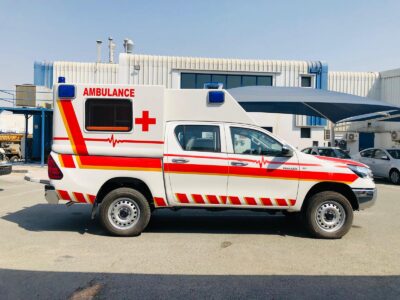
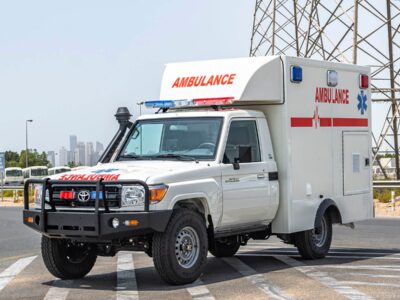
Two distinct configurations dominate the market. The first is a pickup conversion, where the cargo bed houses a weatherproof canopy containing rescue gear and a stretcher. The second is a Toyota Hilux box type ambulance, where a dedicated medical module sits on the rear chassis. Both serve different missions, but both inherit the legendary durability of the Hilux drivetrain.
Typical users include rural EMS agencies, mining companies, humanitarian NGOs, and military field units. These organizations need vehicles that can operate for years without access to sophisticated workshops.
4×4 Performance & Off-Road Capability
The heart of the Hilux appeal lies in its 4×4 system. Unlike soft-roaders with car-based suspensions, the Hilux employs a rugged ladder frame and heavy-duty leaf springs. This architecture withstands the twisting forces of uneven terrain that would crack a monocoque van body.
Ground clearance is exceptional. The Hilux can traverse deep ruts, ford rivers, and climb loose rock without high-centering. The approach and departure angles, critical for steep terrain, allow it to descend into dry riverbeds and climb out the other side.
Equally important is the mechanical simplicity. In remote areas, electronics fail. The Hilux relies on proven diesel engines and manual or heavy-duty automatic transmissions that local mechanics understand. When a breakdown occurs, parts are usually available within days, not weeks.
Box-Type vs Pickup Conversion
Choosing between these two configurations depends entirely on your operational requirements.
The pickup conversion is essentially a rapid response vehicle. The rear canopy typically carries extrication tools, medical jump kits, and a single stretcher. It is lighter, faster, and more maneuverable on tight trails. Rescue teams often prefer this setup because it can carry technical rescue equipment alongside basic medical supplies.
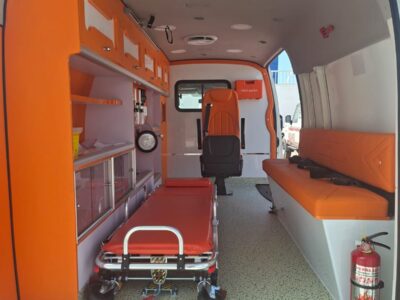
The Toyota Hilux box type ambulance offers something entirely different. The rear module is a fully enclosed medical treatment area. Technicians can work standing inside, attending to patients during transport. This configuration supports advanced life support equipment, multiple stretchers, and climate control systems.
From a maintenance perspective, the box-type offers a significant advantage. If the rear module is damaged in a collision or rollover, it can be unbolted and replaced without scrapping the entire vehicle. The cab and chassis remain serviceable.
Medical Interior & Equipment Options
Inside a Hilux ambulance, the layout prioritizes functionality over luxury. Stretcher systems must lock securely during violent off-road movement, yet release instantly when loading a patient. Pneumatic or spring-loaded stretcher mounts are common.
Medical gas systems require careful integration. Oxygen cylinders must be secured against shock loads. Electrical systems need isolation from the vehicle’s starting battery to ensure the engine can always restart. Modern conversions include inverters for powering monitors and infusion pumps.
For ALS missions, the interior accommodates defibrillators, suction units, and medication storage. Climate control is non-negotiable. In desert operations, interior temperatures can exceed fifty degrees Celsius without adequate insulation and air conditioning.
Typical Use Cases
The versatility of the Hilux platform supports a wide range of emergency medical missions:
- Rural emergency response: Reaching farming communities hours from the nearest hospital
- Disaster relief operations: Navigating earthquake-damaged roads and flooded areas
- Humanitarian aid missions: Supporting mobile clinics in remote villages
- Border patrol medical support: Responding to incidents along remote frontiers
- Mining and oil field operations: Providing on-site medical coverage at remote extraction sites
- Wildfire support: Accessing fire lines to treat exhausted firefighters
Comparison Table
| Feature | Hilux Pickup Ambulance | Hilux Box-Type Ambulance |
|---|---|---|
| Drive Type | 4×4 (part-time or full-time) | 4×4 (part-time or full-time) |
| Interior Space | Limited (stretcher + basic gear) | Full walk-in medical area |
| Best Terrain | Extreme off-road, tight trails | Moderate to severe off-road |
| Customization Level | Moderate (canopy fit-out) | High (dedicated medical module) |
| Typical Users | Rescue teams, rapid response | ALS providers, mobile ICU units |
| Patient Capacity | 1 stretcher | 1–2 stretchers + attendant |
Why Choose a Toyota Hilux Ambulance?
Cost-effectiveness drives many purchasing decisions, and the Hilux delivers. The initial acquisition cost undercuts heavy-duty truck platforms significantly. More importantly, the total cost of ownership remains low because the mechanical components are proven and widely available.
Durability translates directly into lifecycle value. Organizations operating Hilux ambulances routinely report service lives exceeding twenty years with proper maintenance. The chassis resists corrosion, and the drivetrain tolerates operational abuse that would destroy lesser vehicles.
The global service network cannot be overstated. In nearly every country, Toyota maintains dealerships and parts distribution. For NGOs operating across borders, this consistency simplifies logistics. A Hilux ambulance in Chad shares mechanical components with one in Chile.
Conclusion
The Toyota Hilux ambulance represents the gold standard for off-road medical response. Its 4×4 capability opens access to patients in the world’s most challenging environments, while the choice between pickup and box-type configurations allows organizations to match the vehicle precisely to their mission profile.
Whether you need a rapid rescue vehicle for technical extrication or a fully equipped mobile ICU for remote clinics, the Hilux platform delivers the reliability your team depends on. When lives hang in the balance, sending a vehicle that cannot reach the scene is not an option. The Hilux always arrives.
Frequently Asked Questions
Is the Toyota Hilux suitable for ambulance conversion?
Absolutely. The Hilux cab and chassis is specifically designed for conversion work. Its ladder frame provides a stable foundation for mounting medical modules, and the proven mechanical components ensure reliability in demanding conditions.
What is the difference between Hilux box-type and pickup ambulances?
A pickup ambulance uses a canopy on the original cargo bed for basic medical transport and rescue gear. A box-type ambulance replaces the bed with a fully enclosed, walk-in medical module that supports advanced life support equipment and patient care during transit.
Can a Toyota Hilux ambulance be used for ICU or ALS missions?
Yes, but only in the box-type configuration. The walk-in module provides sufficient space for ventilators, monitors, infusion pumps, and medical gas systems. Attendants can work standing during transport, which is essential for critical care.
Why is the Hilux preferred for off-road rescue operations?
The Hilux offers superior ground clearance, heavy-duty suspension, and mechanical simplicity compared to van-based alternatives. Its 4×4 system and durable construction allow it to reach patients in remote areas where conventional ambulances cannot operate.